
What Flowers Value Most
Something They Know More About Than We Do

Over the past couple of months, I have been asking the flowers to take me deeper into their mysteries. Their answers have been beautiful, surprising, profound and sometimes hard. Yet one message keeps returning in different forms, spoken by different flowers, in different places.
They tell me that what they value most is community. In fact, I have come to believe that community may be the deepest wisdom flowers have to offer us—something they have been quietly teaching us for more than 100 million years. This is what we need most from them—both for right now, and for the long-term viability of our species. Survival is something the flowers know a lot about.


As I have been taking in their wisdom, I have noticed something unexpected happening in my own life. Lately, community has been arriving in my life from every direction. It feels so rich, nourishing and comforting. I have connected with both old friends and family I haven’t seen in a long time. I have started volunteering at our local community garden where we raise vegetables for shelters and food banks in our area, and together, we visited another community farm that was so inspiring. I have simply and easily met people I have wanted to get to know for a long time through synchronistic encounters. I attended a retreat/conference and made new friends and connections there. I have started lifting weights in a local gym class and feel connected and supported in my efforts to be stronger and healthier. Several wonderful new books have fed me too, with their communities of ideas and stories. When I look back over the last couple of months, it all feels incredibly rich, on top of the robust communities that I already have. And naturally this has all happened as the spring flowers are bursting into our world and sharing their communities with us. Like the flowers, our own expansions and contractions flow with the seasons.


The first flower to talk to me about community several years ago was the trout lily. Growing in large gatherings connected by their rhizomatous roots, they said to me, “Come dance and skip with us on the forest floor as the bees do. Let our yellow radiance infuse you with delight. The way to be strong is to go slowly and to build strength and resilience a little bit at a time. That way you can weave your roots deeper and deeper, becoming stronger and unable to be uprooted. Our deepest strength is our beloved community.”


“Our deepest strength is our beloved community,” was really all they needed to say.
In a culture that is becoming increasingly fragmented, our longing for nourishing community has grown in direct correlation with our increasing disconnection. Many people have written about this in great detail, and I don’t need to make the case again here. We all feel the loss of traditional communities, and how we used to weave our lives more closely together. Yet the longing for community remains and now fuels the new ways we are finding that work for us in our ever-changing world—evolving in fits and starts—as we learn what is truly nourishing and sustainable today.
Flowers are always found in community if they are left to themselves. Perhaps one reason we often dream about being in rich wildflower meadows is because of the community we intuitively sense there. A lush wildflower meadow is not a stand of individual flowers, but a deeply integrated ecosystem in dynamic conversation with all the beings there. Not only does each variety of flowers develop a cohesive community of their own family, but they are also in deep communication with all the other flowers, plants, insects, birds, animals, fungi, and microbes that share the meadow with them.
They coordinate blooming times so pollinators are shared rather than competed for. They work together to create the best environment for everyone, shading the soil, sharing nutrients through underground mycelial networks, warning each other of threats, and communicating their needs and so much more, through their vast chemical language systems.
These feral gatherings move particularly slowly. No one is in a hurry, as they build new connections on top of days and years and centuries of ecosystems that came before them. They have found their homes, where they belong, where they can do their work. Reveling in each other’s wisdom, they know their medicine is strongest in large communities like this meadow, surrounded by their closest family, feeding each other and protecting each other.
This is something we as humans once knew. In fact, our very survival depended on it. Now the flowers are helping us to see that our survival going forward will once again depend on the strength of our communities. We all long for societies that are fair and provide equitable resources for all people. But increasingly, the reality is that we cannot sit around and wait for the larger communities of our cities, counties, states, and countries to support us. Local communities start with small groups of people, like each and every wildflower meadow. Like each neighborhood garden. We build community where we are, with what we have now, one flower at a time.
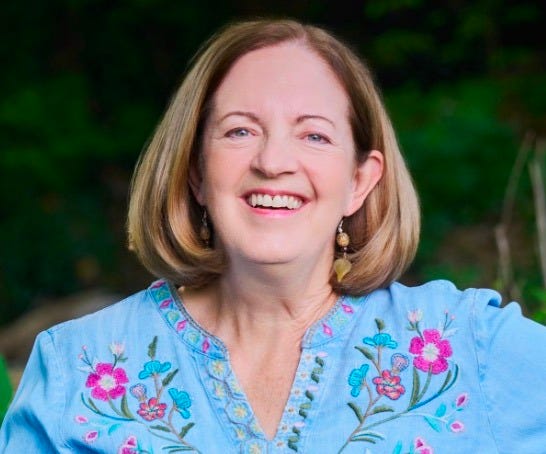
Mary Porter Kerns is the author of the forthcoming book, The Flowers Are Speaking: Listening to Nature’s Ancient Wisdom (Tarcher-Penguin Group, March 2027) that is an intimate journey into the entwined evolution of flowers and human beings—weaving together science, history, stories, and earth-based mysticism to offer a radical vision of how we can best reconnect with the intelligence of plants and the ancient guidance of the earth. In fall of 2022 she self-published the first edition of her oracle cards, also called The Flowers Are Speaking, that sold out in three months.
Her highly acclaimed workshops teach participants how to experience the flowers as she does through their own senses, intuition and imagination.
I received the same message this week when I was sitting in contemplation with nature near an ancient water temple in Sardinia. You have expressed beautifully what the flowers and insects were showing me 💚
An incredibly important piece of writing. I’ve shared it with all the teachers and students in our Forest Meditation Instructor Training program.
Thank you, Mary.
Tamás